
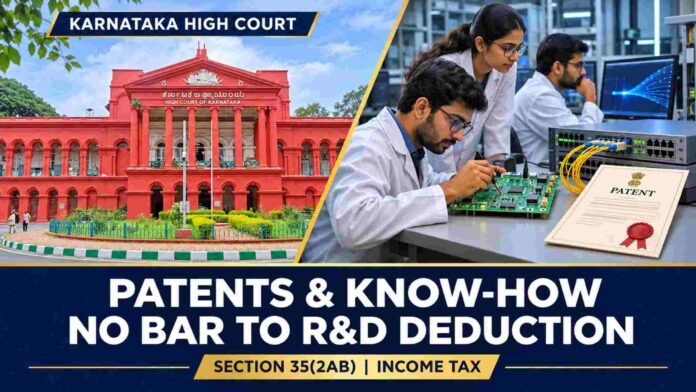
The Karnataka High Court has held that expenditure on in-house scientific research cannot be denied deduction under Section 35(2AB) of the Income Tax Act, 1961 merely because the research results in the development of patents, know-how, technology or other intellectual property.
The Bench of Chief Justice Vibhu Bakhru and Justice K.S. Hemalekha further held that an Assessing Officer cannot undertake a fresh examination of the scientific character of research expenditure approved by the Department of Scientific and Industrial Research (DSIR), the prescribed authority under the statutory framework.
Buy Now: Direct tax (Income Tax) Judgments E-Magazine October 2026
However, the Court clarified that the Assessing Officer retains the power to verify supporting documents, audited accounts and whether the deduction claimed is confined to expenditure approved by the prescribed authority.
The respondent/assessee is a company engaged in software development and the manufacture and trading of networking equipment, filed its return for AY 2009–10 declaring nil income and claiming a loss of ₹7,75,95,922.
Its research activities involved developing optical transmission telecommunication equipment. DSIR had approved its R&D units at J.P. Nagar in Bengaluru and Ghatkopar in Mumbai for the purposes of Section 35(2AB).
The company claimed expenditure of ₹59,56,98,795 at the approved units and sought a weighted deduction of ₹89,35,48,193.
After examining the audited expenses, DSIR issued a report in Form 3CL dated April 10, 2013, approving R&D expenditure, excluding land and buildings, of ₹4,601.95 lakh, approximately ₹46.02 crore.
The Assessing Officer disallowed ₹48,41,82,071 out of the weighted deduction claimed. The disallowance principally related to product development expenditure recorded as revenue expenditure, capital expenditure and capital work-in-progress.
The Dispute Resolution Panel upheld the officer’s approach, following which a final assessment order and consequential demand notice were issued on January 31, 2014.
The company challenged the assessment insofar as it concerned Section 35(2AB). The Single Judge ruled in its favour on April 24, 2015, prompting the Revenue’s appeal.
The Assessing Officer reasoned that expenditure on developing products generated know-how or technology capable of providing an enduring benefit to the company.
According to the officer, this amounted to the creation of an intangible asset and attracted the exclusion under Section 43(4)(ii), which concerns expenditure incurred in acquiring rights in, or arising out of, scientific research.
The officer also treated expenditure on incomplete product development projects as capital work-in-progress and denied the corresponding weighted deduction. Depreciation was allowed on a component treated as know-how.
The central question before the High Court was whether expenditure on a company’s own research becomes ineligible merely because the research produces commercially valuable technology or intellectual property.
Rejecting the Revenue’s interpretation, the Court explained that Section 43(4)(ii) addresses expenditure incurred to acquire an existing right arising from scientific research.
For example, purchasing a patent or rights in a patent from another patentee, without undertaking the underlying research, represents acquisition of an asset. Such expenditure is distinct from money spent by a taxpayer on conducting its own scientific research.
The Bench observed that acquiring knowledge and making technological advancements are the purposes of scientific research. A business would ordinarily undertake such research to advance its commercial activities.
Therefore, the development of know-how, technology or proprietary rights through research does not, by itself, bring the underlying expenditure within the exclusion.
The Court agreed with the interpretation adopted by the Income Tax Appellate Tribunal in Tata Hitachi Construction Machinery Company Limited v. DCIT and Resil Chemicals (P) Ltd. v. DCIT, distinguishing in-house research expenditure from the purchase of rights arising from research conducted by somebody else.
The Bench also rejected the assumption that expenditure must be disallowed under Section 35(2AB) merely because it is capital in nature.
Reading the provision applicable to the assessment year, the Court observed that the deduction covered expenditure on scientific research at an approved in-house R&D facility, while specifically excluding expenditure in the nature of the cost of land or buildings.
Consequently, capital expenditure other than expenditure on land and buildings could not be excluded solely because of its capital character.
Treating product development expenditure as an intangible asset or capital work-in-progress did not, by itself, establish that the expenditure was ineligible under Section 35(2AB).
The High Court examined the approval framework under Section 35 and Rule 6 of the Income Tax Rules, 1962.
The framework requires the prescribed authority to examine the relevant conditions and provides for information concerning research facilities, research objectives and expenditure. It also requires separately maintained and annually audited accounts.
The Bench rejected the contention that the prescribed authority lacked jurisdiction to examine whether expenditure was excluded under Section 43(4)(ii).
It held that the Assessing Officer could not independently reconsider whether approved activities constituted scientific research or substitute a different view regarding the scientific character of approved expenditure.
The prescribed authority’s statutory role could not be displaced through a merits review by the Assessing Officer.
The Court emphasised the procedure under Section 35(3).
Where a question arises as to whether, and to what extent, an activity constitutes scientific research or an asset is used for scientific research, the provision requires a reference through the Central Board of Direct Taxes to the competent authority.
For the activities relevant to this dispute, the question must be referred to the prescribed authority, whose decision is final under the provision.
Accordingly, if the Assessing Officer disputes the scientific character or extent of the activities, the proper course is to seek a reference through the Board. The officer cannot decide that question independently.
The Bench referred to decisions including Deputy CIT v. Mastek Limited, JK Synthetics Limited v. O.S. Bajpai, Income Tax Officer, and CIT v. F.C.S. International Marketing (P) Limited while explaining this division of responsibilities.
The Court nevertheless rejected the suggestion that DSIR approval prevents all scrutiny of a deduction claim.
The Assessing Officer can verify whether the necessary supporting material exists and whether audited accounts establish that the claimed expenditure was incurred.
The officer must also ensure that the deduction sought is confined to expenditure approved by the prescribed authority. This clarification is significant because the company’s expenditure claim and DSIR’s approved amount were different.
However, verification of records and approved limits does not authorise the officer to reopen the scientific merits of the activities or independently redefine approved research as ineligible.
The department also challenged the maintainability of the company’s writ petition against the assessment order.
The Division Bench explained that High Courts generally refrain from entertaining writ petitions where statutory remedies are available as a matter of judicial self-restraint. The availability of such remedies does not remove their jurisdiction under Article 226 of the Constitution.
Here, the Single Judge had entertained the petition because it raised a question concerning the Assessing Officer’s jurisdiction to determine the scientific character of the expenditure and disallow it on the premise that it would generate revenue in future years.
Membership Required to Access Case Details & Order Copy
To view the complete Case Details and Download Order Copy, you must have an active membership. Please subscribe to continue.
Read More: Assessee’s Participation Can’t Cure Missing S. 143(2) Notice: Jharkhand High Court

